
How to Start Bitcoin Mining with an LLC: A Step-by-Step Guide for 2026
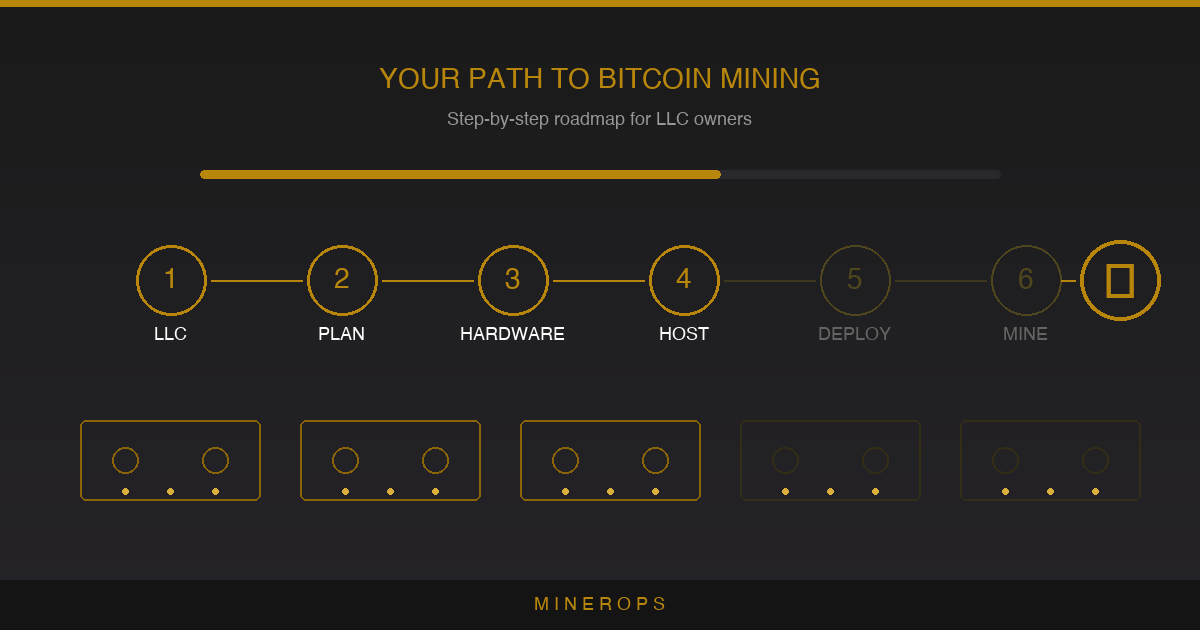
A bitcoin mining LLC is one of the most tax-efficient ways to stack BTC. You’re not buying crypto with after-tax dollars. You’re running a business that produces bitcoin while writing off hardware, electricity, and management fees against your income.
This guide walks you through the whole process, from formation to first bitcoin mined.
Step 1: Form Your Bitcoin Mining LLC
Your bitcoin mining LLC needs a proper business entity structure. An LLC is the most common choice for miners because it provides:
- Liability protection – separating your personal assets from the business
- Tax flexibility – LLCs can be taxed as sole proprietorships, partnerships, or S-corps
- Simplified accounting – clean separation of mining income and expenses
- Depreciation eligibility – business entities can claim Section 179 and bonus depreciation on mining hardware
If you already own an LLC, you can add Bitcoin mining as a business activity. If not, forming one is straightforward in most states and can be done online in under an hour.
Get the LLC set up before you buy any hardware. You want the equipment purchased by and titled to the LLC, not you personally. This matters for depreciation claims.
Step 2: Understand the Economics
Before committing capital, you need to understand the basic economics of Bitcoin mining:
Revenue Drivers
- Bitcoin price – the higher BTC trades, the more your mined coins are worth
- Hash rate – how much computational power your miners produce
- Network difficulty – as more miners join the network, difficulty increases and your share of block rewards decreases
- Block subsidy – currently 3.125 BTC per block after the April 2024 halving
Cost Drivers
- Hardware cost – ASIC miners range from $2,000 to $15,000+ depending on model and efficiency
- Electricity rate – the biggest variable in mining profitability, typically $0.04-$0.08/kWh at professional facilities
- Hosting fees – facility charges for rack space, cooling, and infrastructure
- Management fees – if using a managed service (typically 2-5% of mined BTC)
The Tax Advantage
Here’s what most people miss: even when mining profitability looks thin on a revenue-minus-cost basis, the tax deductions can make your effective cost of acquiring BTC way cheaper than just buying on an exchange. An LLC owner in the 37% tax bracket who mines $100,000 worth of Bitcoin with $100,000 in deductible expenses has essentially acquired that Bitcoin at a 37% discount to market price.
Step 3: Choose Your Approach
You have three realistic options for how to run your mining operation:
Option A: Fully Self-Managed
You source hardware, find a hosting facility, deploy machines, and handle ongoing management yourself. Lowest fees, highest time commitment.
Best for: Technical operators with industry relationships and available time.
Option B: Managed Mining Service
You purchase the hardware (owning the depreciable asset), and a professional operator handles everything else – sourcing, deployment, monitoring, maintenance, and reporting.
Best for: LLC owners who want the tax benefits without the operational burden. This is what MinerOps provides.
Option C: Cloud Mining / Hash Rate Contracts
You buy hash rate from a provider without owning physical hardware. Generally not recommended – you lose the depreciation benefit (the biggest tax advantage), have less control, and the economics are often worse than buying Bitcoin directly.
We don’t recommend this for tax-optimized mining. You lose the depreciation benefit, which is the biggest advantage.
Step 4: Select and Acquire Mining Hardware
If you’re going the managed route, your operator will typically handle hardware sourcing. If you’re self-managing, here’s what to know:
Current Generation Hardware (2026)
The most popular and efficient miners currently include:
- Bitmain Antminer S21 Series – industry standard with excellent efficiency ratings
- MicroBT Whatsminer M60 Series – strong alternative with competitive performance
- Bitmain Antminer S21 Pro – higher hash rate, premium pricing
What Matters Most
Efficiency (joules per terahash) is the most important metric. A more efficient miner produces more Bitcoin per dollar of electricity. Don’t chase the highest hash rate if the efficiency is poor – you’ll pay for it in power costs every month.
Minimum Scale
Most hosting facilities require a minimum of 5-10 miners. Below that, the operational overhead per machine doesn’t make financial sense. MinerOps, for example, requires a minimum of 10 miners for managed operations.
Avoiding Scams
The ASIC market is rife with fraud. Common scams include:
- Selling refurbished units as new
- Flashing firmware to display inflated hash rates
- Taking payment and never delivering
- Counterfeit units from unauthorized manufacturers
Work with verified suppliers or use a managed service that handles procurement through established wholesale channels.
Step 5: Secure Hosting
Your miners need a professional facility with:
- Reliable, low-cost power ($0.07-$0.09/kWh is competitive)
- Adequate cooling – miners generate extreme heat
- Physical security – your hardware is a significant investment
- Network redundancy – downtime means lost Bitcoin
- Responsive on-site staff – for maintenance and emergencies
If you’re using a managed service, they’ll place your miners at a vetted facility from their network. If you’re self-managing, expect to spend significant time researching, visiting, and negotiating with hosting providers.
Step 6: Set Up Your Bitcoin Mining LLC Tax Infrastructure
Before your first miner powers on, make sure your tax infrastructure is ready:
- Dedicated business bank account for your LLC
- Accounting software that can handle cryptocurrency (or a good spreadsheet)
- A CPA or tax professional who understands both business depreciation and cryptocurrency tax rules
- Documentation system for all equipment purchases, invoices, and operational expenses
- Clear records of the “placed in service” date for each piece of hardware (required for depreciation claims)
Step 7: Deploy and Monitor
Once hardware is acquired and hosting is secured:
- Ship machines to the facility (or have your managed service handle this)
- Rack and connect – physical installation and network configuration
- Configure mining software – set pool, wallet address, firmware settings
- Optimize settings – tune for best efficiency at your power rate
- Begin monitoring – uptime, hash rate, temperature, and error rates
With a managed service, you receive a dashboard or monthly report showing production metrics, costs, and BTC deposited to your wallet.
Step 8: Ongoing Operations
Mining takes ongoing work. You’re looking at:
- Responding to hardware failures and coordinating repairs
- Updating firmware when new optimizations are available
- Adjusting settings based on difficulty changes and Bitcoin price movements
- Tracking all expenses for tax purposes
- Evaluating whether to reinvest in newer, more efficient hardware
This is what a managed service handles for you so you can focus on your actual business.
Getting Started with MinerOps
If the managed approach sounds right, here’s how MinerOps works:
- Discovery call – we assess your goals, budget, and tax situation (free, 30 minutes)
- Custom deployment plan – hardware recommendations, projected economics, and tax projections
- Hardware procurement – we source machines at wholesale pricing through our supplier network
- Deployment – machines installed and configured at a vetted facility
- Ongoing management – 24/7 monitoring, maintenance, optimization, and monthly reporting
- Bitcoin to your wallet – mined BTC is sent directly to your self-custody wallet
Once your bitcoin mining LLC is set up with MinerOps, the entire process from discovery call to first Bitcoin produced typically takes 2-4 weeks.
Ready to Get Started?
Book a free 30-minute discovery call. We’ll assess your goals, budget, and tax situation – and build a custom plan for your LLC.